Sorry ![]()
It’s about structuring and simplicity, which is what ANY and ALL are used for.
ANY is actually useless. It works just as well if you just connect the cards, IE remove the ANY.
I just use ANY anywhere I want to prevent multiple lines crossing eachother, or the whole screen…
That is in front or after multiple cards…
A ‘false’ exit on a ANY-cardis nonsense.
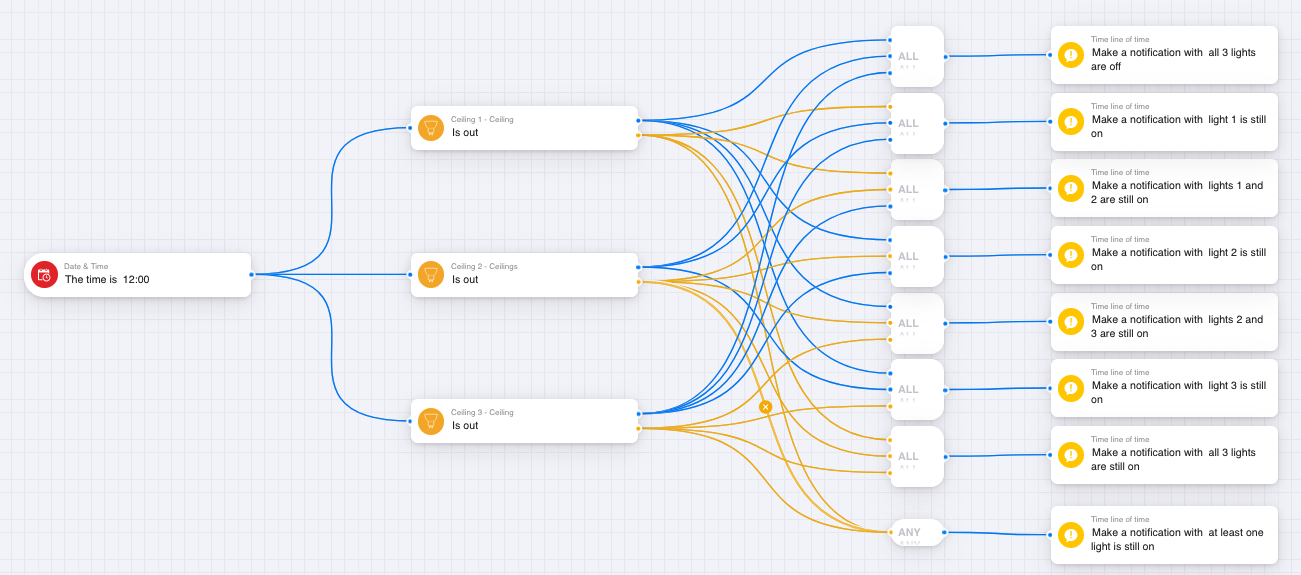
There is no need for a ‘false’-exit on a ALL-card because it can easily be solved like this:
In fact with 3 AND-cards there are 6 different situations why the ALL-card is not true. And each situation may require a different THEN-card action.
A ‘false’ exit on a ANY-cardis nonsense.
I’m not so sure about it. It’s usefull in some sitautions for simplicity:
True, but you don’t need to use an ANY card.
It depends on situation. It’s not always the point to detect all different combinations. Sometimes you need to detect specific combination and spark to muiltiple different inputs. Both outputs, TRUE and FALSE make sense, whether with ANY or ALL, both are useful. Binary arithmetic is incomplete without NOT operator, which can be realised through inverted output.
Of course not, you can make the same logic without ANY, but with many more links in some situations. It’s about structuring in situations where ANY result is sent to multiple inputs.
Let say that all 3 AND-cards are false. That means non of the blue lines will reach the ANY-card.
How is the ANY-card supposed to know that all AND-cards are false?
One off the 3 lights is on. So the ALL-card is false. Any yellow line can trigger an action needed if not all lights are off.