Im moving into a new home and going to create a smart home for the first time. Looking to do an in depth ongoing thread and video content for step by step beginner setup, as well as integrations, automation, and advancements.
Home hardware will be more than adequate- cat 7 runs through the house, wifi 7, server installed and running, fiber, security cams, blue iris server, etc etc will all be installed and operational prior to starting the smart home journey.
What i am not looking to do is reviews or vlogs of multiple platforms.
I want to start with one platform, keep that platform, expand with it, discover work around, etc. In order to help those who are beyond fed up with the bias and inconceivable amount of content and infornation from multiple different platforms.
OTHER than Home assistant, im trying to determine between Homey, Google, or Alexa. Being that the AI integration war has begun, I did like the simplicity of Homey from what ive seen.
Input from those who have used alexa,google,Homey and the pros and cons specicially for beginners, would be greatly appreciated.
Comparing Homey against Google/Alexa feels like an apple-vs-oranges comparison.
Both Google and Alexa are voice assistants. Their goal is to provide the user with information (and, of course, to gather as much information about its users as possible for advertisement purposes). Both platforms are venturing into home automation, but from what I’ve seen their capabilities are relatively limited (though easy to set up).
Homey is not a voice assistant. It’s primary goal is home automation, and with its radios and device support is tries to support all your smart home devices, regardless of protocol or brand. And, at least at the moment, it’s not used to gather user information.
The automation portion of either google or Alexa has long existed. And is popular for beginners or people who solely want basic and user friendly control or basic home automations. I’ve experimented with both in recent years. Just never set up an entire ecosystem.
And being that voice assistant wouldnt be necessary from the start, and probably a good idea for add on to the video content and user guide down the road, I guess that would limit the options to hubs such as hubitat, homey, etc
I think you already pretty much summed it up yourself. Homey and HA are both powerful systems which allows you to connect almost every “smart” device and will let you control and automate all of them. They both have a great community that is actively maintaining open source applications for the platforms. This is also because both systems run on NodeJS which is a widely used platform to develop on. You can write applications in Javascript or Typescript, which are the two most used programming languages nowadays.
Homey is a bit more expensive, but it comes in prepackaged hardware that works out off the box. Its interface and software is also very user friendly and intuitive and it also looks nice (opinion). As a frontend developer, I like Homey because of this.
Home Assistant is cheaper, but also more modular. Before you can do anything, you must built the hardware yourself and install the software on it. I know there are prebuilt packages with preinstalled hardware, but the one packages that comes closest to Homey was just pulled a few weeks ago because it didn’t sell. This is probably because people who chose for HA want the flexibility to built it just the way they want it, and if they don’t need a certain antenna, there’s also no need to already buy it. Also, because of its flexibility and cheaper entry costs, HA has also a slightly larger community. This might help with support for more or nicher products.
But all of this being said, both Homey and HA are prosumer level products. Home Automation is actually pretty complex and difficult to do right on it’s own, and anyone who is in to that should not shy away from a bit of tinkering or a fighting with an unintuitive user interface. Chosing between Homey or HA basically comes down to preference.
None of the other Home automation platforms including Homekit, Google and Alexa come close to both Homey and HA, so I won’t go into those.
I understand that, but I’m not sure what your goal is here. I think the target audience for Google/Alexa isn’t the same as the target audience for Homey.
Why wouldnt it be? Speaking specifically on the smart home front. In total, sure, there are alot if people who buy Amazon or google devices for a range of uses. But there are quite alot who buy them for basic home automation.
Much more than HA or honey currently. Specifically due to ease of use.
I get that people in a forum, or who spend alot of time out of their day or week, think there is a huge population of people who do the same. But that isnt the case. The overwhelming majority of the population involved in smart home tech, use it on a badic level, want user friendliness, ease of use, set up a couple things, and thats that. It isnt their regular hobby.
I’ve spent a significant amount of time watching, listening, reading, demos etc of homey. Other than having more user features, its appears to be the most user friendly and simple of the smart home hubs.
Putting it in the same category of user friendliness as HA, especially for a beginner, isnt even close.
The advancements in hubitat from the first I looked at it years ago, and HA, clearly seem to be much less beginner friendly.
Referring a beginner to homey seems only a step up from alexa or google on the difficulty chart.
Fair enough, if people want something more than what Google/Alexa offer in terms of home automation, then Homey might be a good step up.
However, I think that step might still be significantly large for a lot of people to not take it. It’s not just the cost of the device, but also having to deal with things like device support (which I think is the #1 most confusing part of Homey: “It says it supports brand X, yet it cannot find my devices!”), having to create automations in a rather manual fashion, and just keeping the device running in a stable fashion.
I don’t think I agree with this. In the end, Home automation is just programming. All programming is, is arranging a bunch of if, then and else statements together in a very specific way in order to get a desired outcome. Whether you put them together using a fancy and intuitive interface, or just by writing it manually isn’t the hard part. It’s HOW you arrange them together that is the hard part. Even professionally, some programmers like a nice IDE, others prefer a simpler text editor, but it’s not this preference that defines a good or a bad programmer.
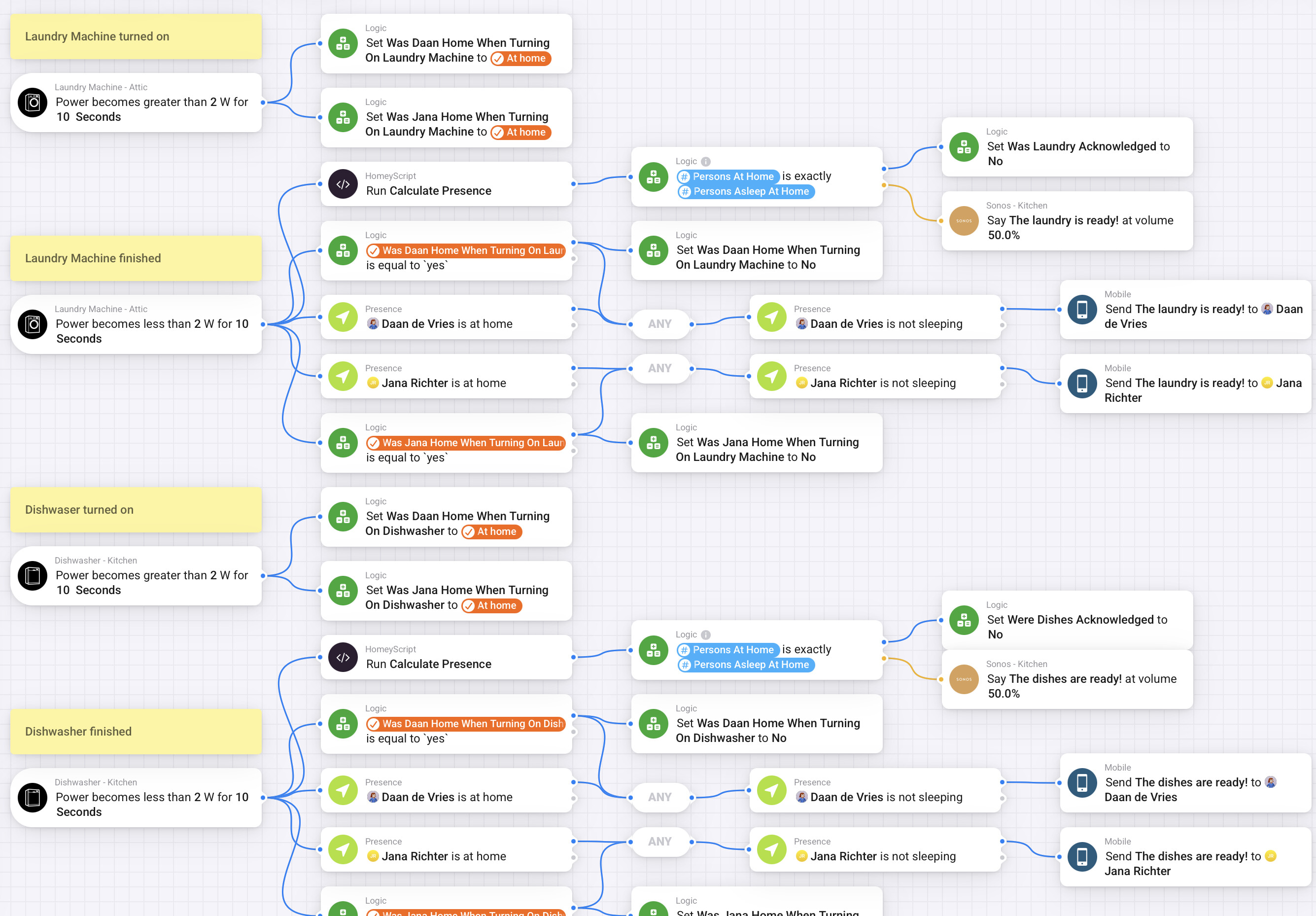
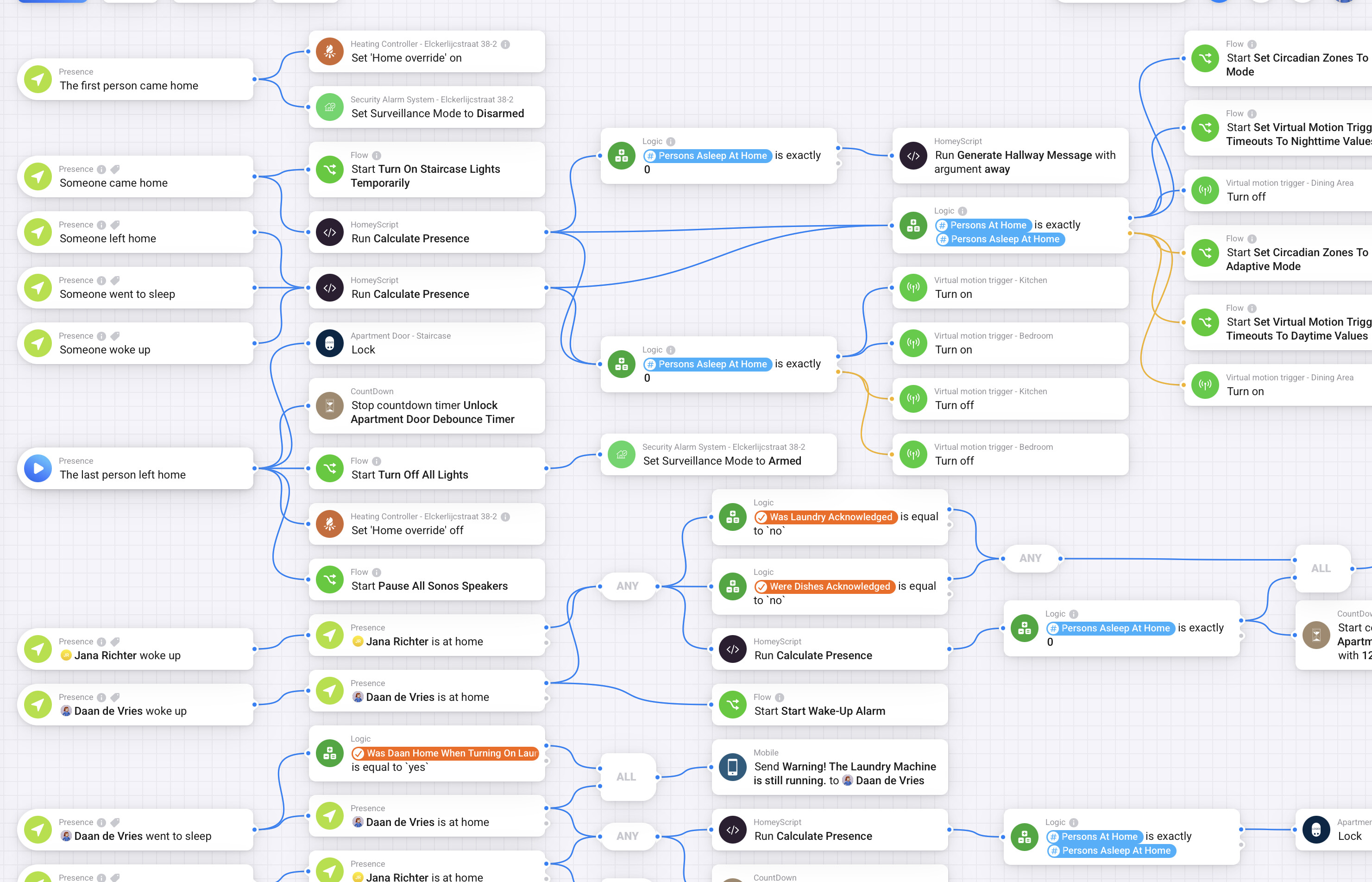
Yes, Homey has a very nice and intuitive interface. I really like the way advanced flows work. But I wouldn’t say that this interface enabled me to do automate things that I otherwise wouldn’t be able to automate. If you’re not able to think like a programmer, or like programming in general, no interface will allow you to build your smart home. Below are some examples of advanced flows that require some advanced programming capabilities to comprehend.
What makes Homey or HA better, but also multitudes more complex and thus difficult than all the other platforms like Google Alexa or Homekit is the amount of devices it supports. The bigger companies like Google and Apple decided to go all in on this new standard Matter and Thread, but the reality is that 90% of current smart devices do not support this standard. And also in the future, I wouldn’t even advice to use matter or thread for certain devices when zigbee, z-wave or even 833mhz are way easier, cheaper and/or more energy efficient options. This is what puts the home automation community off. You can be a very big company with lot’s of resources and employees, but in the the end the strength of the community is larger. There are just not a lot of people building apps to support devices on Homekit or Google and Alexa. Homey’s and HA’s communities are way larger.
So don’t be fooled by the sleek looks of Homey and its interface. It is very much a prosumer product and it’s definitely NOT easy!
Well this is partially incorrect. While google has never supported zwave or zigbee, alexa has had both included in their products for years.
And you say they totally bought jnto matter and thread, but at the same time, HA amd Homey both support matter and thread.
The actual ability to integrate in homey is no different than alexa. They support the same protocols. The only ability homey has that alexa doesnt is RF. So to say homey is that much better than alexa due to that is just not correct.
I think most of your answer just ignores the topic at hand. The topic is user friendliness for beginners. I think that was pretty clear. Thinking or acting line a programmer has absokutely nothing to do with this topic whatsoever.
You dont have to be, or act, or think like a programmer to set up a simple routine with alexa. Which is the ENTIRE point of the topic.
You say the hard part is HOW you arrange them. Well that same concept applies to any of thes hubs. And the hubs innate user friendliness would assist in that task.
I can only come to the conclusion that you either didn’t read, or didnt comprehend the initial question.
I think the biggest problem is to create a nice and intuitive end user experience. Your wife will be a good critical tester of your use cases
For example no need to wave your hands when you sit a while in toilet, no need to switch the light to continuously on when painting your wall in the hall.
Not to mention the burden of software maintenance of Homey ánd the (build in) devices, especially when yoú are on holiday and something has crashed.
Got it. Having never actually gone through and set one up, that was the portion of the project I wasnt familiar with.
And being that I am trying to take a single platform and create a series of beginner steps to a smart home, i want to be aware of pitfalls. Rather than just another review of every and any hub or all the different devices out there, I want to create something that a person can follow along and copy as far as they like. When they reach the point that its enough for them, they stop.
If they want to extend, they pick up where they left off.
But its too hard or time consuming for the majority of the population that isnt up to speed, to try to decipher what hub does what, which ine is better, which sensor is compatible, which interface is easier etc etc.
For the overwhelming majority of the poualtion, this isnt a hobby and they arent an enthusiast. They just want to set some things up, make some cool automations, as easy as possible, have some extra features, and move on.
Hence, the tens of millions google and Amazon hubs sold each year.
The way Homey implements device support is very different, though. Homey by itself has only very limited support for devices, you need to install specific apps to get specific device support, which also means that if a device isn’t explicitly supported by an app, it’s likely to be not supported at all by Homey.
“But Homey supports Zigbee?”
Yes, but out of the box, it only supports simple lights and plugs. No sensors, no additional features.
I think that everyone is trying to tell you that you do have to have more of a programmer’s mind with Homey. And I agree with @dsdevries: even though Homey might be a step up from Alexa/Google, it’s a big step.
While there are some smart home hubs including Homey and HA that can connect to Alexa and relay voice commands, the official Amazon Echo, does not support Zigbee, Z-wave or 433mhz. Also, Google Nest does not these protocols. I’m also not saying that support Matter and Thread is a bad thing. The opposite actually, the more protocols a smart home hub can support, the better.
I indeed might have interpreted your question wrong. I thought you asked for unbiased reviews including pro’s and con’s of each platform, especially for beginners.
I thought I tried to answer that question as honestly and unbiased as possible. However, the word “beginner” implies movement to me. The beginning being the starting point of a certain development. When you look at it like that, then yes, both Homey and HA will have a very steep learning curve. And, trust me, it will be a very long and steep climb for possibly years to come. Things that look easy, will turn out to be very hard and will possibly annoy the hell out of your fellow household members (trust me, it will).
If however, the beginning also means the end for you. Then by all means, pick any smart home hub you like. You will probably be able to do beginners stuff on any of them. If you want to embark on a journey and discover endless possibilities, then Homey and HA, are the only two platforms that currently exist that will support you for a long time.
So, Is it hard? yes!
Is it useful? possibly.
Is it meaningful? I don’t think so.
Is it fun, though? HELL YEAH!
Again, this is my honest unbiased review whilst trying to explain the pros and cons of each platform. I’m sorry if this isn’t the answer you were hoping for.
As I read your initial post, you asked other users view of different eco-systems. That’s what I’ve seen people write here. I’m a bit confused that you seem to just focus on the user-friendliness of (among others) Alexa.
Yes, other ecosystems are probably more user-friendly than Homey. In setting up, in composing simple automations, in using speech.
Homey is very good in complex automations, which I would have no idea how to build them in Alexa or Google.
That’s why I think focusing on one ecosystem is not the end. I use Homey, but also Google for the possibilities of speechprompts. Speech to Google, and speech by Google.
I focus on the user friendliness of alexa because i do have an echo in my house that my wife uses for music, and my daughter who was 12 at the time was easily able to set up multiple basic automations using it without assistance. If that isnt user friendly, I dont know what is.
I guess it depends on what you consider complex automations. Some consider IFTTT to be complex automation.
I agree with others that both are a big step from HomeKit/Google Home/Alexa, but with that step you also get a lot more power. Having speed-run Homey and HA the last few months, some observations:
Both have good on-ramping hardware. Homey has the Pro Mini and Pro (also the Bridge, but I’d skip it, because some community apps are really good and you cannot install them with Cloud + Bridge). People always say that HA is more work to get started because you need to build your own hardware. This is false, the Home Assistant Green is really good and gets you up and running in a few minutes. I’d recommend to also get the Home Assistant Connect ZBT-2 if you go this route, because it enables the large Zigbee ecosystem. Perhaps even two, so you can also use Thread/Matter.
I would say that Homey is easier to get started with. HA is really flexible, but you have to invest some time to properly understand how to design dashboards, etc. Homey dashboards are less powerful, but easier to get started with.
Homey’s advanced flows are really powerful, even though you can unfortunately only edit them in a web browser. Still, this IMO one of the primary features that sets Homey apart (yes, I know there is Node Red).
Home Assistant has wider support for devices (probably due to having a larger community) and for Zigbee devices, support often lands far earlier than on Homey, especially when using Zigbee2MQTT on HA. It also exposes some events better. Like e.g. for the Ikea Somrig button, Homey does not expose an initial press event for the buttons, so there is always going to be a latency if you want to use one of the two buttons as a simple button (no hold/double press behavior). Or e.g. our heat pump manufacturer has an official Homey App, but it does not expose a lot of sensors compared to the HA integration (including basic stuff like the room thermostat).
Homey Pro does not support Zigbee OTA updates, which are sometimes necessary to fix issues with Zigbee devices if you bought them early. E.g., I had an Innr plug that required a firmware update to properly report energy use. (I think to be pedantic, it does support it, but not the apps or something like that) So if you end up using Homey, you might want to get an extra coordinator to do updates with Zigbee2MQTT when needed.
Homey supports Zigbee and Matter, but I would avoid using both at the same time. The support is done using multi-protocol support using a single chip/antenna and my experience has not been good. I started out with adding a lot of Zigbee devices, once I started adding Matter devices, I had a lot of issues with pairing and connectivity.
So far, both have been pretty stable for me, but I have had to ‘repair’ devices a small number of times to the Homey Pro because they disappeared. Not sure why.
When going for Homey Pro, I’d hook it up to ethernet. I had a Homey Bridge before, connected to WiFi and it had the red ring every 1-2 days and the device (temporarily) dropped off WiFi and I sometimes had to reboot it. With Ethernet, there is a solid backup.
The 1GiB RAM in the Pro Mini seems very tight, 4GiB in the Pro 2026 is pretty good.
The Homey Cloud/remote access story is better. With HA, either you need a more technical solution (e.g. CloudFlare tunnels, Tailscale, or port forwarding on your router) or the fairly expensive Nabu Casa subscription. On Homey it just works out-of-the box.
Conversely, the backup story is better with HA. On Homey Pro, you either need the backup subscription (not too expensive though) or do the clumsy local backups. On HA the sky is the limit, S3 storage, B2 storage, OneDrive, WebDAV, Google Drive, etc.
If I had to choose now, I would probably not buy the Homey Pro, the 399 Euro is too steep for the shortcomings. For now I’m keeping it running with the Zigbee2MQTT and Home Assistant community apps to expose a slightly less complex interface for family members. That said, it’s far far better than some of the other Hubs I tried, e.g. SmartThings cannot even reliably run workflows and has pretty limited statistic cards, etc.
The topic was pretty clear. Not sure how the concept of a beginner to something defines much else.
Anyway, i dont think the appropriate viewpoint is to assume homey will support anyone for a long time.
Rather hard to apply that moniker to anything outside of google, amazon, or HA at this point. Especially considering the acquisition isnt even 2 years old yet.
When people start on a new hobby or activity, whether it being in sports, games, or programming and home automation they always start at beginner level. Most of the time however, people either intentionally or automatically gain knowledge, experience and confidence so to move up to novice, advanced, intermediate, expert or even master level. When that happens, people sometimes realize that the beginner level equipment they purchased no longer matches with what they demand/expect from it. So when I said that Homey or HA will support for a long time, I didn’t meant that from a technical support point of view, but more a requirements point of view.
Having said all of this, I still don’t understand what you want us to say. It seems that you already made up your mind to which product you will buy and only want us to confirm your decision. I’ve already said that if you indeed have no intention of doing anything more than beginner level automations, you can pick any smart home hub you want as it will probably be able to support you with that.
Whichever one you pick, I trust you will be happy with it. Good luck with your decision.